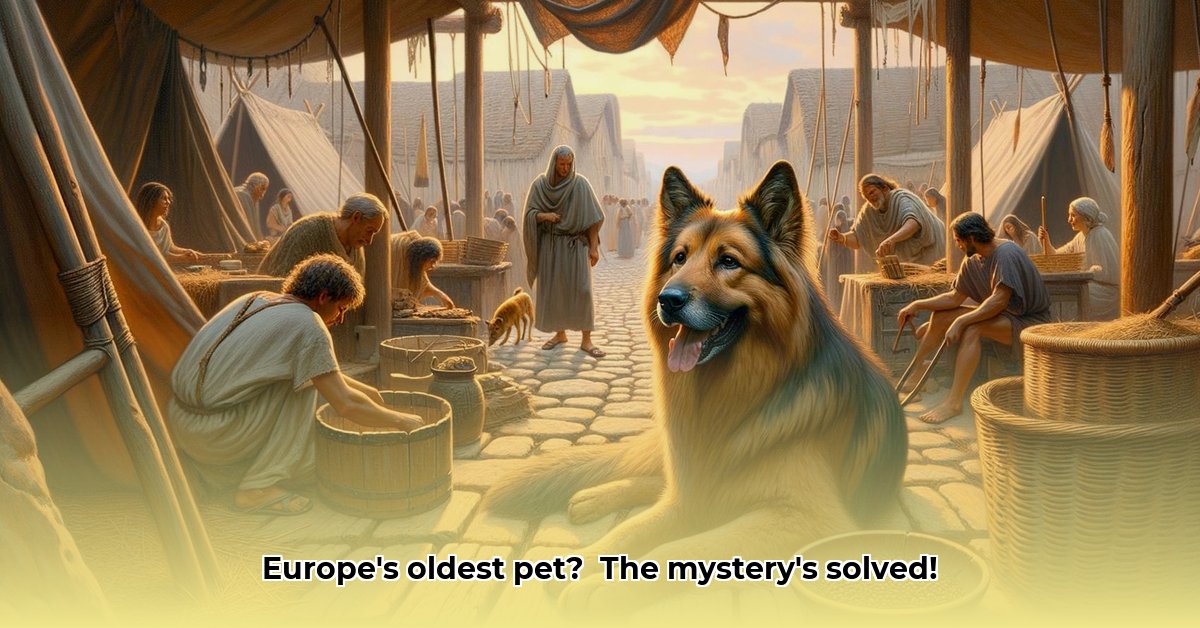
Europe's First Furry Friend: A Complex Puzzle
Who was Europe's first domesticated animal? This seemingly simple question has puzzled historians and archaeologists for decades. The evidence, often fragmented and incomplete, paints a picture far more complex than a simple "whodunnit." This article delves into the ongoing investigation, exploring the challenges of identifying ancient animal remains, examining the leading contenders, and highlighting the collaborative efforts required to solve this age-old mystery. The quest to pinpoint Europe's oldest four-legged companion is a fascinating story of scientific detective work, revealing much about our shared history with animals.
Did you know that even identifying the species of ancient animal bones can present a significant challenge? The passage of time, varying preservation conditions, and the often fragmentary nature of the remains all contribute to the complexity. But by piecing together the available evidence, including genetic analysis, radiocarbon dating, and archaeological context, a clearer picture emerges, though many questions remain.
The Prime Suspect: Canis familiaris
The dog (Canis familiaris) stands as the leading candidate for Europe's oldest domesticated animal. Numerous ancient canine remains have been unearthed across the continent, hinting at a long and intertwined history between humans and dogs. However, precisely dating the initial domestication event remains challenging. Did it occur simultaneously across Europe, or was it a more gradual process with various regions developing independent relationships with dogs? These questions illustrate the nuances of this scientific puzzle.
Has anyone found a complete skeleton? Rarely. More typically, researchers work with fragmented remains, meticulously piecing together skeletal scraps, much like assembling a jigsaw puzzle with missing pieces. This difficulty adds another layer to dating and identification and emphasises the need for sophisticated techniques and meticulous analysis.
The Challenges of Time and Preservation
Dating ancient bones is no small task. Radiocarbon dating provides a broad timeframe, but its accuracy is limited. Furthermore, the preservation of bone is greatly influenced by environmental factors. Some environments preserve bones beautifully; others leave behind only fragments or dust. Therefore, the condition and location of a find significantly impact the information we can glean from it. This variability requires careful consideration when interpreting data. What are the limitations of radiocarbon dating, and what are the potential biases involved? It's vital we acknowledge these limitations.
What percentage of discoveries provide complete and undamaged skeletons? The frustrating answer is, a very small percentage.
Contenders and Uncertainties
While dogs remain the leading contender, other animals also vie for the title of Europe's oldest domesticated companions. Sheep, goats, and cattle were all domesticated early on in European history, further complicating the quest to determine which was first. The incomplete nature of much of the available evidence makes a definitive determination challenging. This highlights the limitations of our current understanding of early animal domestication practices in Europe. Researchers require a significant amount of further investigation to confirm, clarify, and refine our understanding.
How do we confidently exclude other animal species from being identified as Europe's oldest domesticated animal? The difficulty lies not only in the fragmentary nature of remains but also in determining definitively whether certain traits in bone structure reflect domestication or other factors.
A Multidisciplinary Approach: The Path Forward
Solving this historical mystery requires a multidisciplinary approach. Archaeologists, geneticists, and other specialists must combine their expertise, sharing data and insights to build a more comprehensive understanding. Accurate dating techniques, detailed DNA analysis, coupled with rigorous bone studies, are all crucial. Moreover, broadening the geographical scope beyond Europe's borders is essential, as the origin of Europe's earliest domesticated animals may, in fact, lie outside the continent.
Steps Towards a Solution
- Advanced Dating Techniques: Employing cutting-edge technologies like improved radiocarbon dating coupled with techniques like Bayesian statistics offers a more refined understanding of timelines.
- International Collaboration: Sharing data and resources across countries exponentially enhances research potential.
- Improved Preservation Methods: Investing in improved preservation methods ensures that more information can be extracted from ancient remains.
- Multifaceted Analysis: Combining genetic, anatomical, and archaeological data provides a holistic view of the past.
How effective are these methods in resolving the question of Europe's oldest domesticated animal? Even with advanced techniques, identifying with absolute certainty the very first domesticated animal remains a formidable challenge.
Unresolved Questions and Future Research
The mystery of Europe's oldest four-legged companion is far from solved. While significant strides have been made, there are numerous open questions that require further research. Refinements in dating techniques, expansion of genetic databases, and enhanced collaborative efforts across disciplines will continue to yield new insights into our shared past with animals. As Professor Patricia Vargas, an expert in archaeozoology at the University of Alicante, Spain, stated, "We’re continually refining our techniques, and with each new discovery and analysis, the story becomes more nuanced."
The investigation of Europe's oldest four-letter pet is an ongoing adventure, a testament to the power of scientific inquiry and the enduring fascination with our shared history with the animal kingdom.